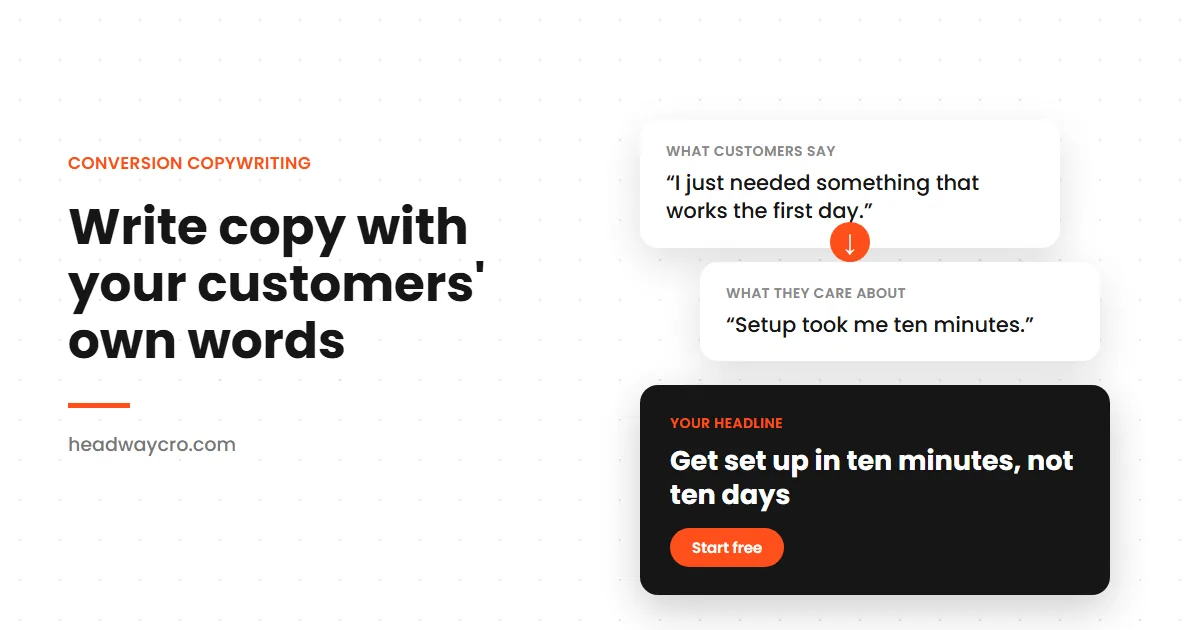
Your page gets visitors. Almost none of them sign up.
AI can now write clean, average copy in seconds. So the pages that win in 2027 are the ones that sound like real customers, because nobody can fake that.
Conversion copywriting is research-led writing that gets a visitor to take one clear action, such as starting a free trial, booking a demo, or signing up. For SaaS, a good conversion copywriting strategy starts with customer voice, which means the real words buyers use about their problem, and then tests the result.
Top SaaS copywriting services usually write this kind of customer-led copy for clients. If you would rather hand it off, see our SaaS copywriting service. Here are the key elements for conversion copywriting.
Key elements of conversion copywriting
- Customer voice. Real reviews, surveys, and interviews replace guesses about what buyers care about.
- Persuasion. Giving the reader a clear reason to act, based on what they care about.
- User experience. Understanding how visitors move through the page, so the copy meets them at the right moment and doesn’t create any friction.
- Messaging strategy. Deciding what to say, in what order, and to whom, before writing a line.
- Testing. Every change is checked against real behavior before you trust it.
The process
- Research. Collect what customers say through reviews, surveys, pop-ups, and interviews.
- Write. Turn those words into a value proposition, a hero section, benefits, proof, and a button.
- Validate. Check the page with five-second tests, user testing, and A/B tests, then repeat.
The steps below show you how to do each one, with templates for the research.
Most SaaS pages skip the first step. They list features, use words nobody says out loud, and hope the visitor works out the rest.
So visitors leave, ad spend goes to waste, and the team blames the traffic. The steps below fix that.
What is conversion copywriting?
Conversion copywriting is writing that turns a reader into someone who takes one clear action, like starting a free trial, booking a demo, or signing up. It uses customer research and testing instead of guesses. Its success is measured in conversion rate, not in how nice the writing sounds.
For a SaaS company, a conversion can be a trial start, a demo booking, a signup, or an email subscription. Smaller steps count too, like a visit to the pricing page. These are called micro conversions.
This kind of conversion-focused copywriting works best when it starts from what customers care about: their pain points, their goals, and the worries they have before they buy.
That is why the first step in this guide is research.
Conversion copywriting vs direct response, brand, SEO and content writing
Conversion copywriting aims at one action and is checked with data. Other kinds of copy aim at other jobs, like building a brand, selling by mail, or ranking in search.
| Type | Main goal | How you know it worked | Where you see it |
|---|---|---|---|
| Conversion copywriting | One action, such as a trial signup | Conversion rate and test results | Landing pages, pricing pages, signup emails |
| Direct response | An immediate sale or reply | Orders or replies from one campaign | Sales letters, mail, ads |
| Brand copywriting | Memory and feeling | Recall and trust, which are harder to measure | Taglines, about pages, packaging |
| SEO copywriting | Search visits | Rankings and organic traffic | Blog posts, category pages |
| Content writing | Teach and keep readers | Reads, shares and return visits | Blog posts, newsletters |
Direct response is the ancestor of conversion copywriting. Joanna Wiebe of Copyhackers also tells writers to study the old direct response copywriters, like John Caples and Schwartz.
The big difference is how you check the work. Direct response leans on proven rules. Conversion copywriting adds research before you write and testing after you launch.
SEO copywriting brings people to the page. Conversion copywriting persuades them once they arrive.
The conversion copywriting process in 3 steps
The process has three steps: research, write, and validate. Each step feeds the next, and what you learn in step three sends you back to step one.
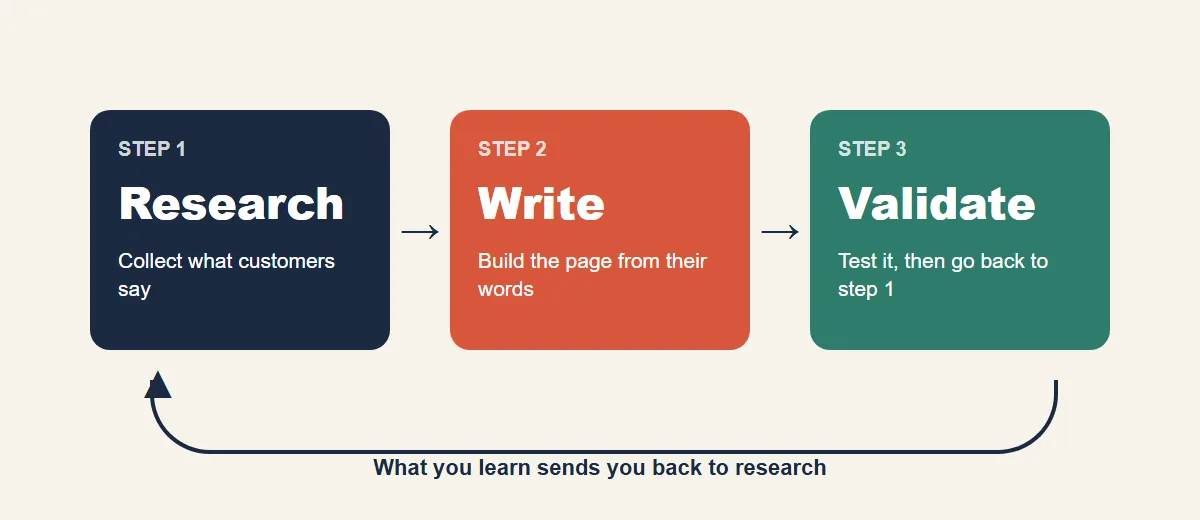
Conversion copywriting 101 comes down to these three steps.
Research is the biggest step. Most people skip it and jump straight to writing.
Validation is the step that stops you from shipping a page that only sounds good to you.
Step 1. Research your customers
Research means collecting the words your customers use about their problem, their goal, and their doubts. You have six ways to do it, and the first one is free.
Each method below has two parts: one line on how to do it, and a template.
These six methods are an overview of the process, not a full playbook. Put everything you collect into one sheet, then look for themes to understand what your audience cares about most. Let that lead your page.
1. Review mining
Review mining means reading real reviews and copying the exact words customers use. It is the fastest way to start, because you do not need customers of your own.
- How to do it. Read reviews of your product and your competitors on sites like G2, Capterra, and Reddit, copy the exact phrases customers use, and tally the problems and goals that repeat. Use what you find to shape your messaging.
Tag each review in a small table like this, then count how often each problem repeats.
| Review (exact words) | Problem | Goal | Sticky phrase |
|---|---|---|---|
| “Setup took us three days and we nearly quit” | Slow setup | Get started fast | “nearly quit” |
| “I never know which leads to call first” | Can’t tell which leads matter | Call the right people first | “never know which” |
2. Customer survey
A customer survey is a short email sent to people who have already bought. It tells you why they chose you, in their own words.
- How to do it. Email recent buyers a few open questions about why they bought, what nearly stopped them, and what they hoped to achieve, then use their answers to shape your core message.
Five questions cover most of what you need.
- When did you realize you needed a product like ours?
- What problem does it fix for you?
- Did you consider other options?
- What worried you before you decided?
- What goal do you hope to reach with it?
3. Pop-up survey
A pop-up survey is a one- or two-question box that appears on a key page. It catches visitors while the doubt is fresh.
- How to do it. Show one or two short questions on a key page, like pricing, to learn why visitors came and what holds them back, then use the answers to clear up their doubts.
Use these three questions.
- What brought you here today?
- Is anything holding you back from signing up today?
- Can we answer any questions before you leave?
4. Customer interview
A customer interview is a short call where a real customer tells the story of why they bought. It gives you the richest quotes.
- How to do it. Talk to a few happy customers for about 30 minutes each about why they bought, then use their stories and phrases to shape your message.
Havice suggests four questions.
- How has using the product improved your work or life?
- What has your experience been like?
- What problem led you to the product?
- What do you dislike about products like this?
5. Thank-you page survey
A thank-you page survey is one question shown right after someone signs up. People are in a good mood at that moment, so they answer more honestly.
- How to do it. Ask one question right after signup about what brought people here, then use the answers to understand the problem they lived with and the result they want.
Ask these two questions, one at a time.
- What was going on in your life that brought you here today?
- Now that you have signed up, what are you going to do first?
6. Obstacle interview
An obstacle interview asks people what almost stopped them from buying. It shows the fears and switching costs that block signups.
- How to do it. Ask recent buyers and long-time users what worried them or nearly stopped them, then use those doubts to address objections in your copy.
Ask these six questions.
- What worries you about using this product?
- What is your biggest fear about buying it?
- What would make you hesitate to leave your current tool?
- What about it feels overwhelming?
- What would help you get past those fears?
- Does anything about it seem too good to be true?
Then follow up with “Can you tell me more?” “Why do you feel that way?” and “What would change your mind about that?”
Step 2. Write the page from customer words
Writing the page means turning your research into a value proposition, a hero section, benefits, proof, and a clear button. Build each part from customer phrases, not from your feature list.
Write your value proposition first
A value proposition is one customer-facing sentence that says what is in it for the reader. It is not a mission statement.
A good value proposition has four things. It is clear, so a reader gets it in one read. It is specific, so it names a real result. It is about the customer, so it speaks to their problem and goal. It is different, so it says why you and not another tool.
Joanna Wiebe’s 10x Web Copy offers two simple formulas. “The only [category] made for [audience] to [outcome]” and “We [do this], but the difference is [that]”.
Write the hero section
The hero section is the top of the page. It has a headline, a subheadline, a button and a proof point or image, and it must make the right visitor think “this is for me” in seconds.
It matters because it is the first thing visitors see, and it decides whether they keep reading or leave.
Pick the hero type that fits your research.
| Hero type | Use it when | Shape of the headline |
|---|---|---|
| Value proposition | Visitors know what they need | What you do and the result |
| Problem-based | Research shows an active pain | Name the pain in their words |
| Dream-state | Research shows a clear goal | Describe the future they want |
| Segment-specific | One role or company size | Name the group in the headline |
| Campaign | An ad or promo sends the traffic | Short, offer first, matches the ad |
Add a small eyebrow line above the headline when it helps. It can name the product feature, the role or the audience, which makes the page feel made for that reader.
These rules from 10x Web Copy keep a hero clear.
- Lead with where the reader ends up. Say the result first and the method second.
- Write to “you”. Start sentences with “you” or “your” so the focus stays on the reader.
- Use one thought per sentence. Cut commas and dashes that glue ideas together.
- Leave a gap on purpose. An unfinished thought at the top makes people scroll to find the answer.
- Skip yes or no questions in the headline. A visitor can answer no and leave.
- Use a hero button only for ready buyers. If people need context first, leave the button for further down.
Break the headline lines by hand, so the key words sit at the start of each line where scanning eyes land first. Quoting the reader in the first person can also work, like “I’m tired of guessing which leads to call”. It mirrors the thought already in their head.
Write the subheadline to back up the headline. 10x Web Copy gives three simple shapes.
- Product, benefit, and how. “[Product] gives you [benefit] by [feature].”
- With and get. “With [feature], get [benefit].”
- Instead of. “Instead of [bad outcome], with [feature], you [good outcome].”
For a dream-state headline, try “Now you can [benefit] without [pain]” or “Never [bad outcome] again”.
See a real hero section picked apart in our free trial landing page teardown.
Turn features into benefits
A feature says what the product does. A benefit says why the reader should care. Benefits matter because people buy the outcome they want, not the feature that delivers it.
Conversion copywriting example. This is an illustration, not a real customer. The feature is lead scoring. The benefit is that you call the best leads first and close more deals.
Add social proof
Social proof is evidence from other people that your claim is true. Put it near the top and near the button, and make it specific.
| Proof type | What it is | Where to place it |
|---|---|---|
| Logo bar | Logos of known customers | Under the hero |
| Trust bar | Security badges, guarantees and press logos | Under the hero |
| Testimonial bar | Real quotes with real names and photos | Under each feature |
| Case study numbers | One real result from one customer | Near features and pricing |
| Reviews and ratings | Star scores from review sites | Near pricing and the button |
| Mixed bar | Logos, numbers and quotes together | Near the button |
A specific quote beats vague praise. Let customers say you are great.
Place proof where the doubt appears. A trust bar under the hero builds quick credibility. A testimonial under a feature backs up that one claim. Mix logos, numbers, and quotes near the price and the button to reduce anxiety.
Use real photos and real names with testimonials, and pick the number that matters to the reader, like time saved or errors cut, only when it is true and you can show it.
Write the call to action and button copy
A good button tells the reader what they get and removes the fear of clicking. Write it in the first person and put a short reassurance next to it.
- Ask for value early. Buttons like “Get my free guide” work in the top and middle of a page. Save a plain action like “Complete purchase” for the end.
- Use first person. “Start my free trial” reads like the reader’s own thought.
- Avoid effort words. Submit, buy, and sign up sound like work or cost.
- Add click triggers. Short lines like “No credit card required” or “Cancel anytime” sit next to the button and lower the doubt.
- Use one call to action per page. Two competing buttons split attention.
A call to value names what the reader gets, like “Get my free audit”. A plain call to action names the step, like “Complete purchase”.
Value works better early, when the reader is still deciding, and the plain step works at the end, when the decision is made.
Treat the hero button with care. If your product needs explaining, a button in the hero invites curiosity clicks that never turn into trials. In that case, let the reader scroll first.
High-conversion copywriting principles and formulas
These six high-conversion copywriting principles apply to every page.
- Specific beats vague. “Stop rebuilding the same report every Monday” is clearer than “save time”.
- Clear beats clever. If a stranger cannot explain the page in one sentence, the copy is written for you, not for them.
- One hook, one offer, one action. Joanna Wiebe’s advice is to pick one pain, one fix and one next step.
- One thought per sentence. Short sentences are easier to scan. Split any sentence that carries two ideas.
- Write to the reader. Use “you” and talk about their problem. Turn “We offer personalized plans” into “You get a plan built around your goals”.
- Bold two or three key phrases per paragraph. Scanning readers catch them first.
Read your draft out loud. If you stumble, the reader will too.
Step 3. Validate the copy
Validating means checking that real people understand and respond to your copy. Start with cheap tests before launch, then run an A/B test if your traffic allows.
Check traffic and offer first
Check the traffic and the offer before you touch the words, because copy cannot fix the wrong visitors or a weak deal.
10x Web Copy ranks them in that order. The list of visitors comes first, the offer second, and the copy third.
A great headline cannot fix traffic from the wrong audience. It also cannot rescue an offer that feels risky or unclear.
Ask three questions. Are the right people arriving? Does the page match the ad or link that sent them? Is the offer clear, including trial length, whether a card is needed, and any guarantee?
Write a hypothesis
A hypothesis is a clear guess you can test. Write it as “Because customers said this, changing that should lift this result.”
Conversion copywriting example. This is an illustration. Reviewers say setup takes too long. Changing the hero to “Set up in minutes” speaks to that worry and should raise trial starts.
Change one thing at a time so you know what caused the result.
Keep a simple test log with the hypothesis, the change, the dates, and the result. It becomes your own record of what your customers respond to.
Run a five-second test
A five-second test shows people a screenshot of your page for five seconds, then asks what they remember. It tells you if the headline is clear.
- Take a clean screenshot of your hero section.
- Show it to about 50 people who match your buyer. Lyssna, which was called UsabilityHub until it rebranded, runs these tests.
- Ask two questions. Who is this page for, and what is this page about?
- Run the test twice, with the two questions in opposite order, so the first question does not bias the second.
- Remove answers from people who are clearly not your buyer.
If people cannot say who the page is for and what it offers, rewrite the headline and subheadline.
Test the clean hero only, not a messy draft. A half-finished layout creates confusion that has nothing to do with your words.
Judge the answers with care. If a few testers mix up a basic term, that is noise from the wrong audience, not a reason to change your plan.
Run user testing
User testing means watching a few real people explore your page while they think out loud. It shows where they get confused, doubt a claim, or stop.
Use five to seven testers who match your buyer. Give neutral tasks like “look at the page and say how you might use it”. Tools like UserTesting run these sessions.
Keep the tasks short and neutral. For example, ask them to open the page, say how they might use it, and try to find the information they would need. Avoid words like “react”, because they push people to give opinions.
Watch what testers do, not what they say about your copy. Their writing advice is rarely useful, but their hesitation tells you exactly where to add proof or clarity.
Run an A/B test when traffic allows
An A/B test shows version A to half your visitors and version B to the other half, then compares their conversion rates. Change one thing at a time and set the sample size before you start.
Optimizely calls 95% statistical significance an accepted standard. The visitors you need depend on your starting conversion rate and the smallest change you want to detect. Optimizely’s sample size guide shows how fast the numbers grow.
| Starting conversion rate | Smallest change to detect | Visitors needed per version |
|---|---|---|
| 15% | 10% | 7,271 |
| 10% | 10% | 12,243 |
| 3% | 10% | 51,141 |
| 10% | 5% | 59,401 |
| 10% | 3% | 185,661 |
Important. Do not stop a test just because it hits significance early. Decide the sample size first and let the test finish.
A small site may never reach these numbers. Optimizely’s advice for low-traffic sites is to test bigger changes with a bigger expected effect. You can also lean on the five-second test, user testing, and polls, which need far fewer people.
VWO, Optimizely, and Mida are tools that run A/B tests.
Test your page in this order. Start with the headline and hero type, then the button copy, then the proof. Large changes show results faster than tiny word swaps.
When a test ends, ask why the winner won, not only which one won. Carry that lesson to your other pages, then feed it back into step one.
What AI can and can’t do in conversion copywriting
AI is good at sorting reviews and drafting variations. It cannot decide which customer pain matters most, and it does not know what your buyers actually said.
Use it for the slow parts. Paste in your reviews and ask it to group them under a problem, a goal or a doubt, and to keep the customer’s exact words in a separate column.
Try this prompt. “Here are 40 customer reviews. Group each one under a problem, a goal or a doubt. Keep the customer’s exact words in their own column and do not rewrite them.”
Then check about 20 of the tags by hand. If they are off, fix the theme names and run it again.
Pro Tip. Remove names and emails before you paste customer data into any AI tool.
AI makes average copy cheap, so customer words are what make your page different. Let AI handle the sorting and let your research decide the message.
Conversion copywriting FAQ
What is the 80/20 rule in copywriting?
The 80/20 rule is a rule of thumb: a small part of your work drives most of the results. In copy, that usually means the headline and the offer matter more than the rest of the page. Spend your time there first. Treat it as a guide, not a measured law.
What is an example of a conversion in marketing?
A conversion is any step toward your goal that a visitor takes. A SaaS example is a visitor starting a free trial. Others are booking a demo, downloading a guide or joining an email list.
Is copywriting still worth learning in 2027?
Yes, for writers who can research and test. AI makes average copy cheap, so the skill that pays is knowing what customers say and which version works. Which conversion copywriting courses are worth taking?
Copy School by Copyhackers is one option, and CXL offers conversion training too.
What are the main types of copywriting?
Common types are brand copywriting, direct response, SEO copywriting, content writing, and conversion copywriting. Writers split them by goal, by channel, or by niche, so lists differ from site to site.
How is AI changing copywriting jobs?
AI now drafts first versions fast, so more of the job is research, judgment, and testing. Writers who bring real customer language and prove what works stay valuable. This is an opinion, not a measured trend.
Start with one page
Pick one page, like your homepage or pricing page. Collect 20 reviews, write the page from what customers said, and test it before you trust it.
Once the new copy is live, run the full-funnel audit checklist to see where people still drop off.
Not sure which page to fix first? Score your pages with the landing page optimization checklist and start with the lowest score.
That is the whole strategy. Research, write, validate, repeat.
If you want help, see how I rewrite SaaS pages from customer research. You can also find more guides on the Headway CRO blog.
Real customer words are the one thing a competitor cannot copy.